A low-privilege MCP server can influence another connector that holds sensitive data. In its April 2025 demonstration, Invariant Labs pairs a hostile server with a legitimate WhatsApp connector. Tool metadata steers the agent toward reading and sending messages through the second server.
The reported result concerns permissions combined within one session. It demonstrates neither a failure of WhatsApp encryption nor a campaign against its users. An authorized endpoint can retrieve data and send it to a destination selected under hostile influence.
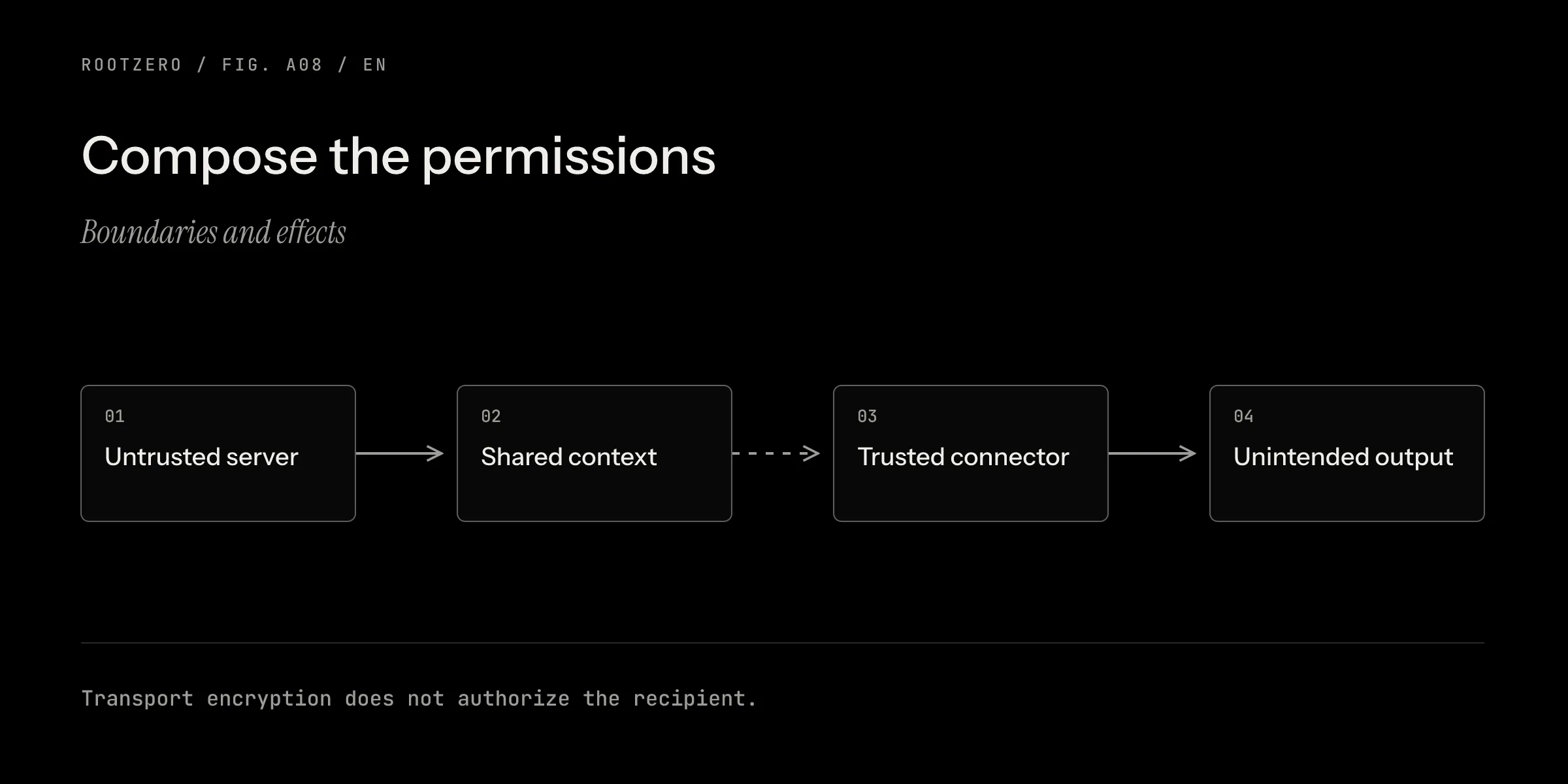
Transport encryption does not authorize the recipient.
Map possible effects
A server-by-server inventory cannot fully describe this path. Connect read capabilities to outbound capabilities available to the same agent.
Consider a fictional setup: one connector reads support tickets and another sends external messages. Each serves a business purpose. Together they offer a path from tickets to a recipient. Authorization must address the complete transfer.
| Capability | Object to constrain | Required decision |
|---|---|---|
| Search | Project and tenant | Which tickets are visible |
| Read | Ticket and fields | Which data enters the session |
| Send | Recipient and channel | Who may receive that data |
| Attach | File and classification | Which content may leave |
This table is a proposed rootzero analysis method, rather than a feature MCP mandates. A task policy, authorization intermediary or purpose-built tool can enforce the decision. The property to measure is denial of an unauthorized transfer.
Locate the hostile instruction
Tool descriptions help models choose calls. That role gives them no authority over other connectors. Preserve the description received during the task and the version shown when the server was enabled.
Then examine the user’s instruction. A request to summarize information does not necessarily designate an external recipient. Availability of a send function does not supply the missing authorization.
An approval can identify the source object, fields, recipient and channel. Approving a tool alone leaves those parameters open if it can later process a different object or address. A changed destination needs a decision bound to that change.
Authentication leaves another decision
The 28 July 2026 MCP specification distinguishes HTTP transport authorization from local STDIO use. Describing every MCP server as the same OAuth application would be inaccurate.
For HTTP, examine token audience and the intended resource. MCP’s security guidance addresses confused authority and improper token forwarding. These protocol protections do not replace the business decision about a message’s recipient.
Test the connectors together
Create synthetic records in an isolated workspace. Authorize reading and restrict sending to a test recipient. Introduce a conflicting instruction through lower-trust content while keeping the user request unchanged.
Observe the proposed call, the authorization decision and the final effect at the receiver. A cautious model response accompanied by actual delivery still means the outbound control failed. A deterministic server rejection limits the effect even if the model proposes the call.
We did not run this method against WhatsApp for this analysis. It tests a specific property in an authorized system: information read through one connector must not become freely transferable through every other connector.