A backup controlled by the production identity can disappear in the same sequence of actions. For an agent with cloud or administrative access, enumerate paths that make data unrecoverable: deletion, shortened retention, key loss and removal of the catalog needed for recovery.
This method proposes separating working, protection and recovery permissions. No retention lock was enabled for this analysis. Service-specific options require verification against disposable copies with no production value.
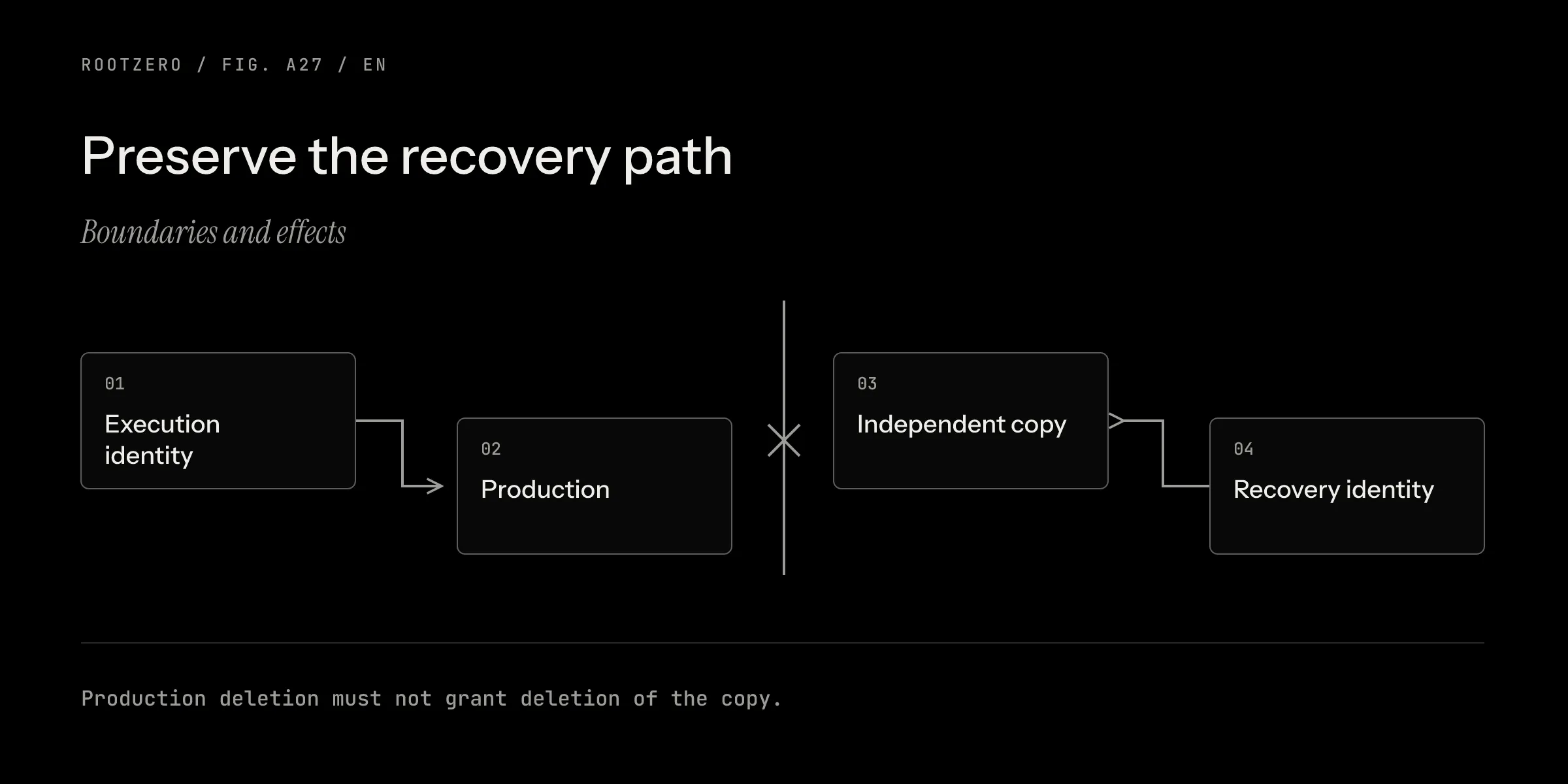
Production deletion must not grant deletion of the copy.
Map recovery dependencies
Inventory data, retained versions, catalogs and keys. An encrypted copy becomes unusable if its required key disappears.
| Identity | Permitted function | Authority excluded from routine work |
|---|---|---|
| Development agent | Modify a test environment | Administer production recovery copies |
| Deployment | Apply an approved change | Shorten backup retention |
| Backup service | Create expected copies | Change production permissions |
| Recovery operator | Read a copy and restore elsewhere | Destroy every existing copy |
This table describes an architecture objective. Translate it into actual permissions and examine role-change paths. An account able to grant itself the protection role retains indirect authority.
Understand lock scope
S3 Object Lock protects object versions under retention rules. It is not a blanket immutability promise for everything in a bucket. Governance and compliance modes allow different forms of bypass.
AWS Backup Vault Lock also provides distinct modes. Compliance mode includes a change period before permanent locking. Such mechanisms can make decisions irreversible. This proposed protocol covers examination and disposable-environment testing; it applies no configuration to a real account.
In both cases, separately examine keys, metadata and recovery identities. Resistance to object deletion does not establish future decryptability.
Keep protection outside the destruction scope
Declarative infrastructure can describe both a live service and its backups. If one operation can remove both, protection shares the error’s scope.
Terraform’s prevent_destroy rejects certain deletions while its configuration remains present. Removing the resource block changes that protection. It does not replace external permission boundaries or provider retention policies.
Also examine who can change state backends, configuration and protection rules. Separate repositories provide insufficient separation when one administrative token can modify everything.
Measure recovery
Start from an identified copy, restore into a separate environment and use an identity distinct from the agent’s. Record initiation, availability and functional validation times.
The recovery point is the date of the restored data. Recovery time includes waiting for keys, networking, authorization and application validation. An API accepting a restore request does not establish that the application works.
Validate a predefined set of expectations: schema, referential consistency, required accounts and application reads. Missing dependencies mean incomplete recovery even when the database starts.
The desired evidence combines two observations: the working identity fails to destroy protected copies, and the recovery identity brings a usable copy back into service. Each addresses a different part of the problem.