Revoking an agent’s new actions does not undo an operation already sent to its target. Evaluate stopping at separate stages: proposal, queuing, final authorization and committed effect.
This protocol extends the scope-guardrails note. The accompanying demonstration models local decisions using fictional times. It controls no agent, calls no model and sends no network traffic.
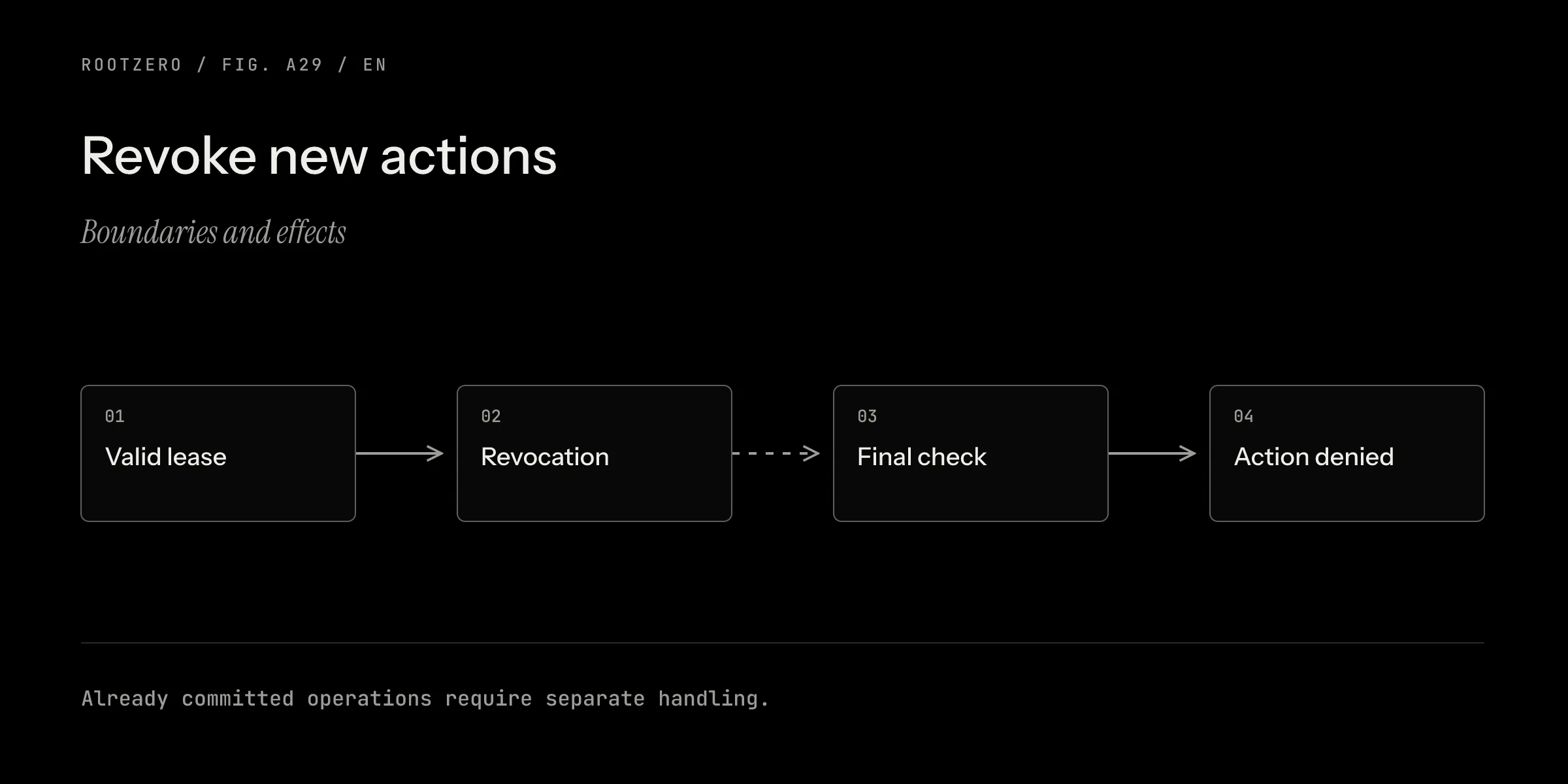
Already committed operations require separate handling.
Check at commitment time
A controller can issue a short-lived authorization, or lease. Before committing an action, the executor checks presence, expiry, scope and generation.
Generation separates an old authorization from a resumed session. An action queued before revocation requires another check when leaving the queue. Checking only when the model proposes the command leaves queued work carrying expired authorizations.
proposal -> queue -> lease check -> committed effect
                        ^
                    revocation
A distributed implementation needs a precise ordering rule between revocation and commitment. The local model simulates neither network partitions nor consensus. It checks functional rules before real-system measurement.
Reproduce the eight model decisions
The downloadable Node program uses standard modules only. From the source repository root:
node docs/drafts/labs/agent-lease.mjsIt checks:
| Case | Expected result |
|---|---|
| Present, valid lease within scope | Allow |
| Time equals expiry | Deny |
| Revoked lease | Deny |
| Old generation | Deny |
| Different scope | Deny |
| Missing lease | Deny |
| Queued action followed by revocation | Deny at final check |
| Effect committed before revocation | Recorded effect remains |
The last row matters. The model does not erase history to suggest revocation reverses the past. Recovery or compensation requires a separate operation.
Then measure the real system
Lease duration alone does not determine stopping latency. Authorization caches, propagation, queues and the final blocking point all affect it.
An instrumented exercise should retain four times: stop request, authority acknowledgment, executor’s final decision and target receipt. Use a monotonic clock for local durations. Across machines, document synchronization uncertainty rather than blindly subtracting timestamps.
Gray and Cheriton’s work on leases provides a framework for time-limited rights in distributed systems. Including a lease in a design does not establish that every access passes through it.
Examine routes around the controller
An agent holding direct credentials may continue through another path. A child process may retain a socket or already started task. Include subprocesses, direct access and external queues in the exercise scope.
Report an observed bound for a stated configuration, the number of trials and operations still running. The eight local cases check decision logic; they establish neither that bound nor a product’s stopping behavior.