An integration token grants data access according to the application’s authorization and associated identity. If stolen, changing a user password may not stop its use.
GTIG and Mandiant describe compromised Drift OAuth tokens used against Salesforce instances between August 8 and 18, 2025. Their August 28 update expands review to other integrations and limits the affected Google Workspace accounts. The report does not describe compromise of Google Workspace itself.
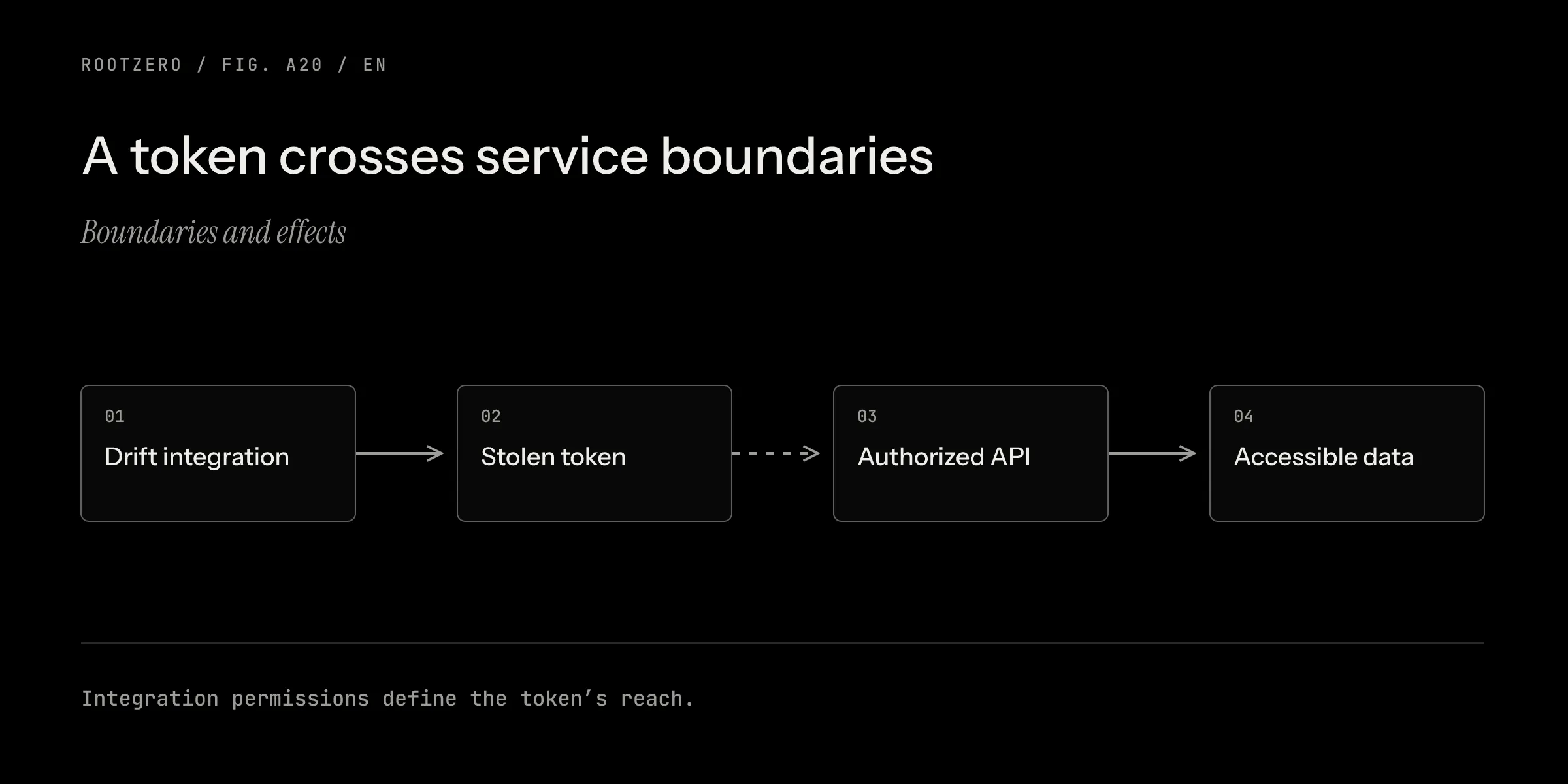
Integration permissions define the token’s reach.
Requests carry the integration identity
A bearer token is usable by its holder within the service’s validity and scope rules. RFC 6750 explains this possession model. A resource server need not require the authorizing person to repeat MFA for each request.
Keep four objects separate: client application, connection user, authorization grant and issued tokens. The chatbot’s commercial name does not describe their permissions.
| Object | Useful investigation record |
|---|---|
| Application | Client identifier and installed integrations |
| Connection identity | Service account and effective permissions |
| Authorization | Granted scopes and accessible objects |
| Token or session | Issuance, expiry, revocation and observed usage |
Valid-token use does not establish that the legitimate software sent a request. The application identity can be correctly recognized while its access material has changed hands.
A CRM can contain further credentials
An application reading tickets or notes can encounter secrets copied by users. Exposure can then extend beyond the initial grant to credentials inside retrieved objects.
Prove that extension. Reading a ticket naming a service does not establish possession of a valid secret for it. Connect accessed objects, their contents and subsequent authentications rather than treat every provider name as another compromise.
Not every step requires the assistant’s model. The report documents an integration compromise; it does not establish that a model selected exports or that prompt injection occurred.
Reconstruct accessed scope
Successful authentication is a starting point. Establish data access through API requests and objects actually returned. Log availability depends on the service and its offering.
Retain time, application identity, session identifier and requested resources. IP addresses and user-agents can select an investigation window, but do not uniquely identify the actor or exclude other token usage.
Compare suspicious calls with expected integration activity. A scheduled job can legitimately export substantial data. Account, destination and timing context help avoid labeling every bulk operation anomalous.
Reduce capability after the incident
Address grants and tokens, then secondary secrets whose exposure is established or plausible within scope. Verify denial at consuming services. Removing a connector from its interface does not establish revocation of every session.
Review which objects the integration must read, for how long and from which origins. A useful integration can retain restricted scope. A remediation test should show normal functionality working while an out-of-scope read fails.