A compromised connector can leave several capabilities active: access token, refresh token, application session and a secret discovered in retrieved data. Revocation must address them separately and verify the resulting effect.
This proposed method starts from GTIG’s Salesloft Drift account. Example names and identifiers are fictional. It assumes neither identical revocation behavior across services nor password changes covering every branch.
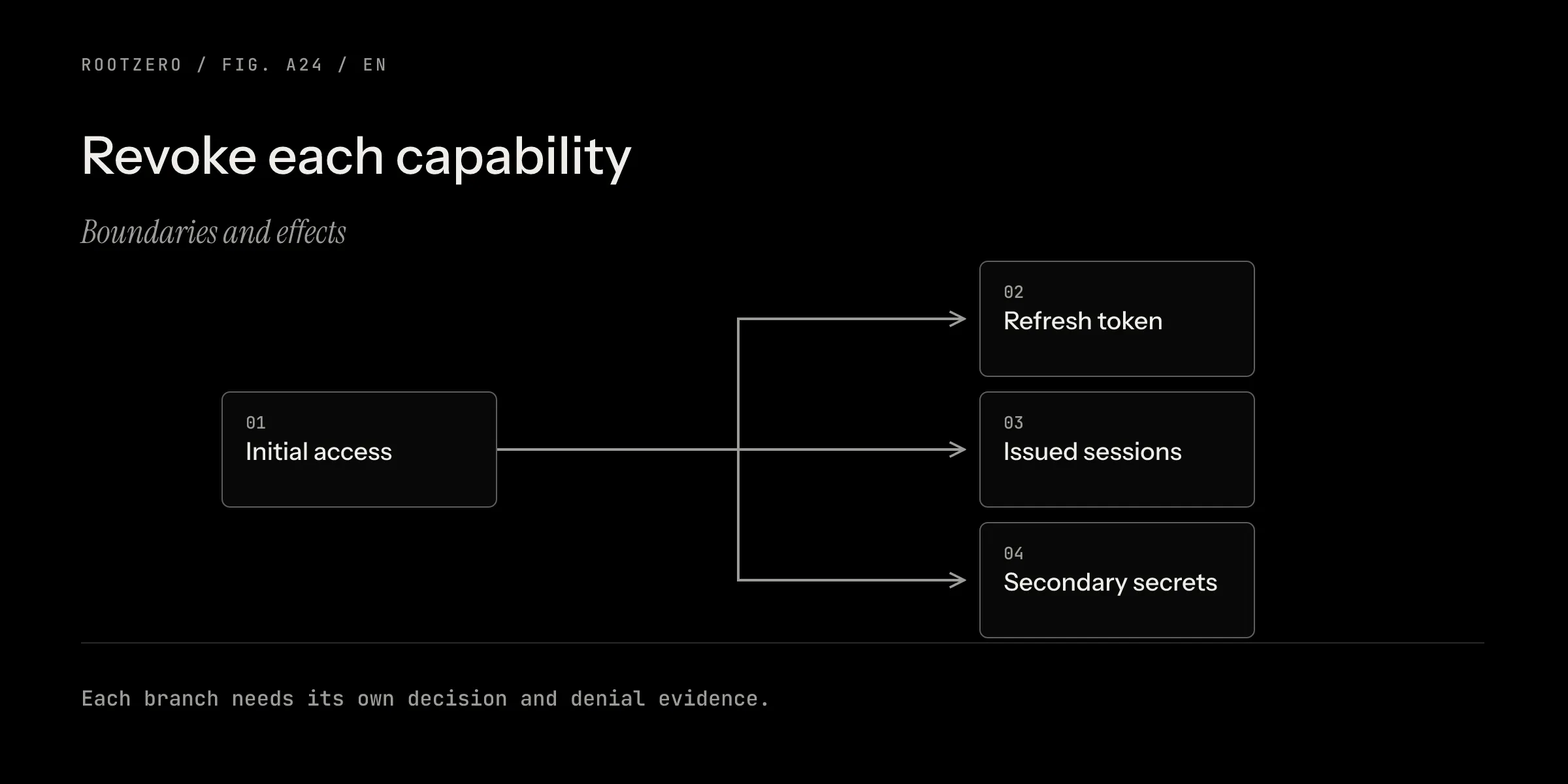
Each branch needs its own decision and denial evidence.
Draw the branches before rotation
A refresh token can obtain access tokens under authorization-server policy. An existing session may follow a different lifetime. A key extracted from a document is another authorization.
application-A grant -> refresh token -> access token -> service-B read
                                                 -> found secret -> service-C access
Revoking only the first visible key can leave other branches usable. Conversely, an access-token request failing does not establish that refresh is impossible.
RFC 7009 defines OAuth token revocation and possible relationships between tokens. It does not replace implementation documentation or resource-side propagation measurement.
Preserve evidence without copying secrets
Record a token reference, family, issuance time and associated resources without retaining its secret value.
{
  "credential_ref": "token-fixture-17",
  "client_id": "application-A",
  "grant_ref": "grant-4",
  "resource": "service-B",
  "revocation_requested_at": "2026-11-15T10:00:00Z",
  "resource_denial_observed_at": null
}
The last field stays empty until denial is observed. Revocation-endpoint acknowledgment and resource-API rejection are different observations.
Retain HTTP status, request identifier and operation type. A 403 may indicate missing scope; a 401 may concern a token that expired before intervention. Interpretation requires a known control and timeline.
Organize containment
Real containment should not wait for exhaustive collection. Preserve available references while promptly interrupting identified access, then investigate using retained logs.
| Action | Expected verification |
|---|---|
| Revoke grant | Associated refresh fails under service policy |
| Revoke sessions | An earlier test session can no longer read the protected object |
| Replace secondary secret | The old value no longer permits the selected operation |
| Reduce rights | Useful work succeeds and excluded reads fail |
Use test accounts and objects where production verification could cause effects or expose real data. Do not extrapolate results to unexamined token families.
Reconnect with reduced capability
Rotation can fail if the new value is reinjected into the compromised environment. Examine the workstation, service or provider that stored it before reconnecting.
Then grant only required access and identify who can remove it. Retain post-revocation usage evidence to distinguish propagation, independent sessions and renewed compromise. Missing logs do not resolve that distinction.