Automatic issue triage has no functional need to publish an extension. Clinejection connects those operations through a third object: a CI cache consumed by a more privileged job. The important boundary lies between the workflows.
Adnan Khan describes an injection in an issue title processed by a Claude-based workflow. His demonstration on a mirror reaches publishing credentials through cache poisoning. A later update distinguishes exploitation by another actor and an unauthorized CLI release that installed OpenClaw. Those stages belong at different points in the timeline.
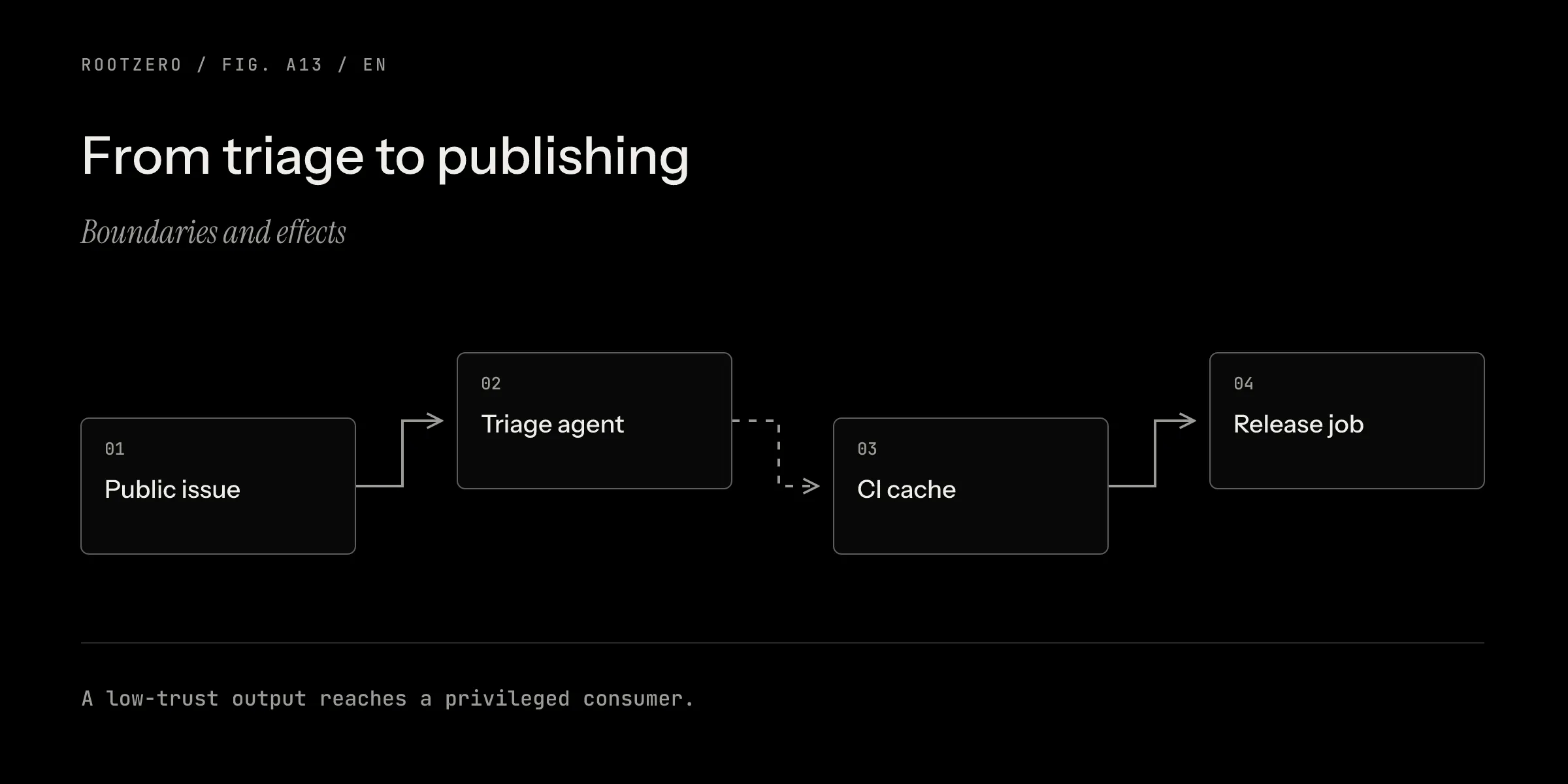
A low-trust output reaches a privileged consumer.
An issue becomes an execution instruction
The issue author controls the title. The model receives it to classify the request. If the agent has a shell, accepting an instruction from that title can result in a command running with the runner’s identity.
Two controls are involved. The client must treat public content as observation. The execution system must also restrict what the process can do when it misinterprets an observation as an instruction. A prompt warning does not change operating-system permissions.
A cache carries trust into the next job
A cache is produced in one job and restored elsewhere. If an untrusted task can change material that a publishing job executes, the consumer inherits a decision made by the producer.
The researcher’s chain is:
public title -> triage agent -> runner execution
             -> poisoned cache -> publishing job
             -> publishing credentials
This illustrates a CI property: withholding secrets from the first job is insufficient when its output becomes code executed with the second job’s secrets. Permissions and producer-consumer relationships both matter.
An existing Actions cache is immutable. Poisoning can involve creating an entry the consumer later selects; it does not require rewriting bytes in an already stored entry. Key and context selection belong in the review.
GitHub documents cache access and restrictions. Restore behavior depends on branches, keys and workflow contexts. This diagram therefore does not imply that every Actions cache can be poisoned through the same route.
Review the transition between workflows
For an authorized review, collect these records:
| Element | Evidence to retain |
|---|---|
| Public input | Exact field and triggering event |
| Triage capability | Token permissions and process access |
| Artifact crossing the boundary | Cache key, restored content and origin |
| Consumer job | Executed code and available credentials |
A cache key describes a selection. It does not establish that the selected content came from a producer trusted by the publishing process.
Remediation must break the relationship. One option is to rebuild executable material from an approved revision in a separate publishing job. Another is to remove the vulnerable automation. The appropriate choice depends on the actual chain; GitHub also documents untrusted-input risks.
Preserve chronology and scope
The original account and subsequent updates reflect different knowledge. A PoC establishes a technical path; the later account of an unauthorized release adds a real event. Combining their dates would attribute to the researcher an action he explicitly separates from his testing.
For a comparable CI, start with artifacts executed by privileged jobs. Then identify which public-input tasks can produce or modify them. This workflow-graph review also applies to triage systems that use no model.