An implant can execute a model’s decisions without containing an AI component itself. Kaspersky’s CyberStrikeAI research examines this separation between remote planning and local effects.
The November 2, 2026 report describes education-sector intrusions in Africa and Latin America. In the reconstructed case, human initial access precedes a pause and deployment of an implant controlled by an LLM orchestrator. The reported three-to-four-day progression to privileged accounts concerns the post-deployment phase, not the full initial timeline.
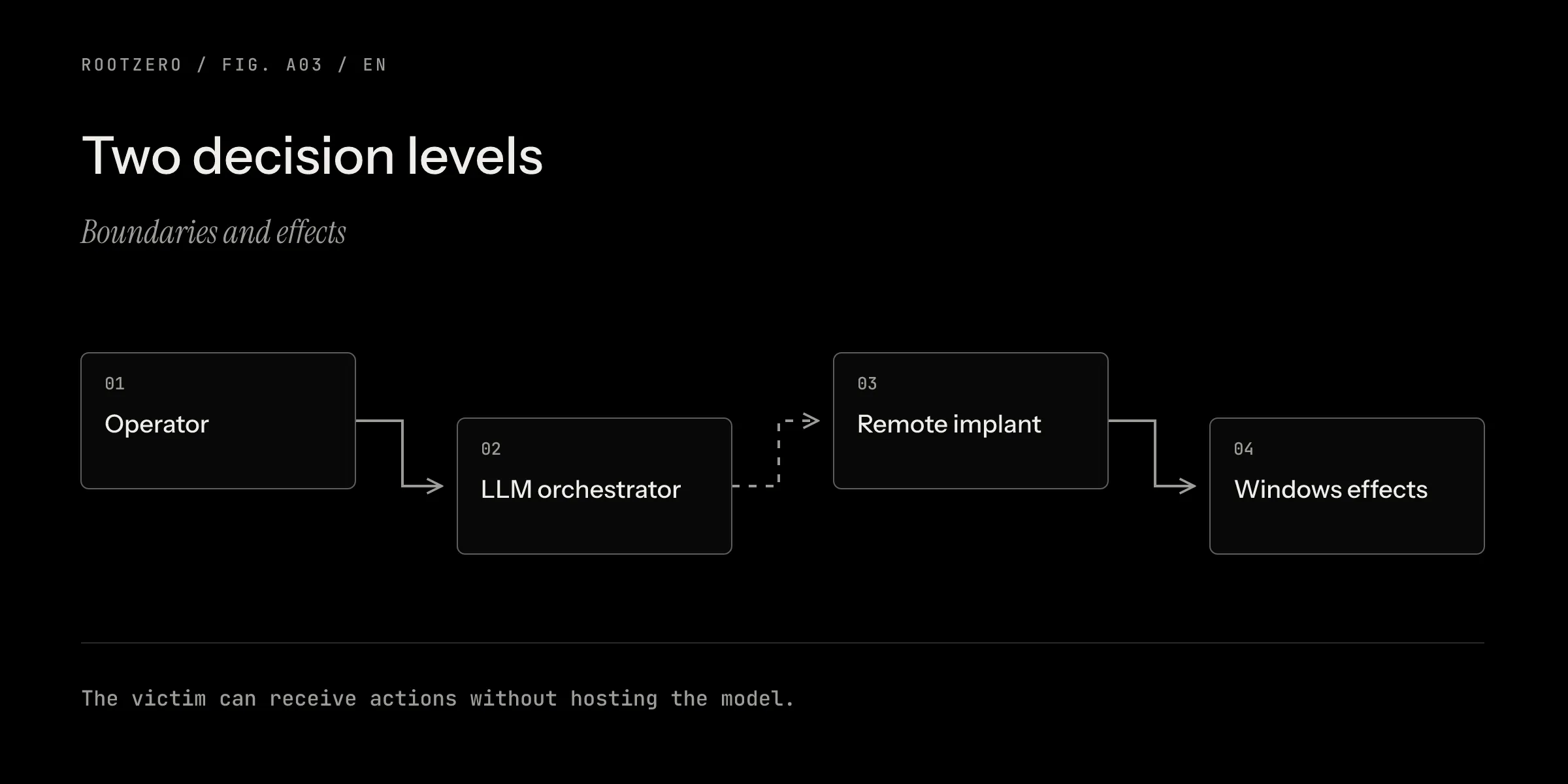
The victim can receive actions without hosting the model.
Separate three roles
The operator defines the objective. The orchestrator selects tools and prepares commands. The implant executes them with permissions available on the compromised host.
This changes expected observations. A victim workstation may make no model-provider requests. It may show child processes, memory access, SMB or WMI connections and C2 traffic. Absence of a Claude-named process or inference engine therefore cannot exclude remote orchestration.
operator goal -> C2-side decision -> command
              <- analyzed result <- implant
Returning results closes the loop. An isolated command without feedback does not establish adaptive behavior.
Identify what telemetry establishes
Victim logs describe actions. Orchestrator-side material may explain selection. These evidence families support different conclusions.
| Evidence | Supported observation |
|---|---|
| Process and arguments | A command executed in a particular context |
| Network connection | Communication between endpoints |
| Session transcript | An instruction or response recorded by the orchestrator |
| Target-system state | The effect actually obtained |
Correlate a transcript’s success claim with target state. Rapid command sequences alone cannot distinguish scripts, skilled operators and agents.
Kaspersky supports its architectural attribution through its investigation. That case is not a universal AI-attack signature.
Investigate known technical effects
Start with persistence, credential access and lateral movement. Common tools are not automatically malicious: administration, backup and authorized testing may use the same primitives.
Correlate account, host, parent process and time. Directory replication by an unexpected identity warrants investigation even without visible model traffic. Microsoft documents directory-operation auditing requirements.
State the baseline: expected replication accounts, administrative origins and authorized tasks. A long-standing exception may remain an exploitable path; age does not establish current legitimacy.
Report an actionable chain
Name initial entry, observed capabilities and unconfirmed steps. Separate intrusion start, implant deployment and privilege acquisition.
Two useful conclusions remain: the model can operate outside the victim network, and controls must reject prohibited effects regardless of who generates commands. Access control and segmentation do not depend on a model’s commercial identity.