An AD replication operation and access to LSASS describe different mechanisms. Correlation can help reconstruct an intrusion, but establishes neither dump contents nor language-model involvement.
This fixture checks one relationship: associate a 4662 operation with a 4624 logon on the same domain controller within the same boot context. Events are fictional and normalized for the exercise.
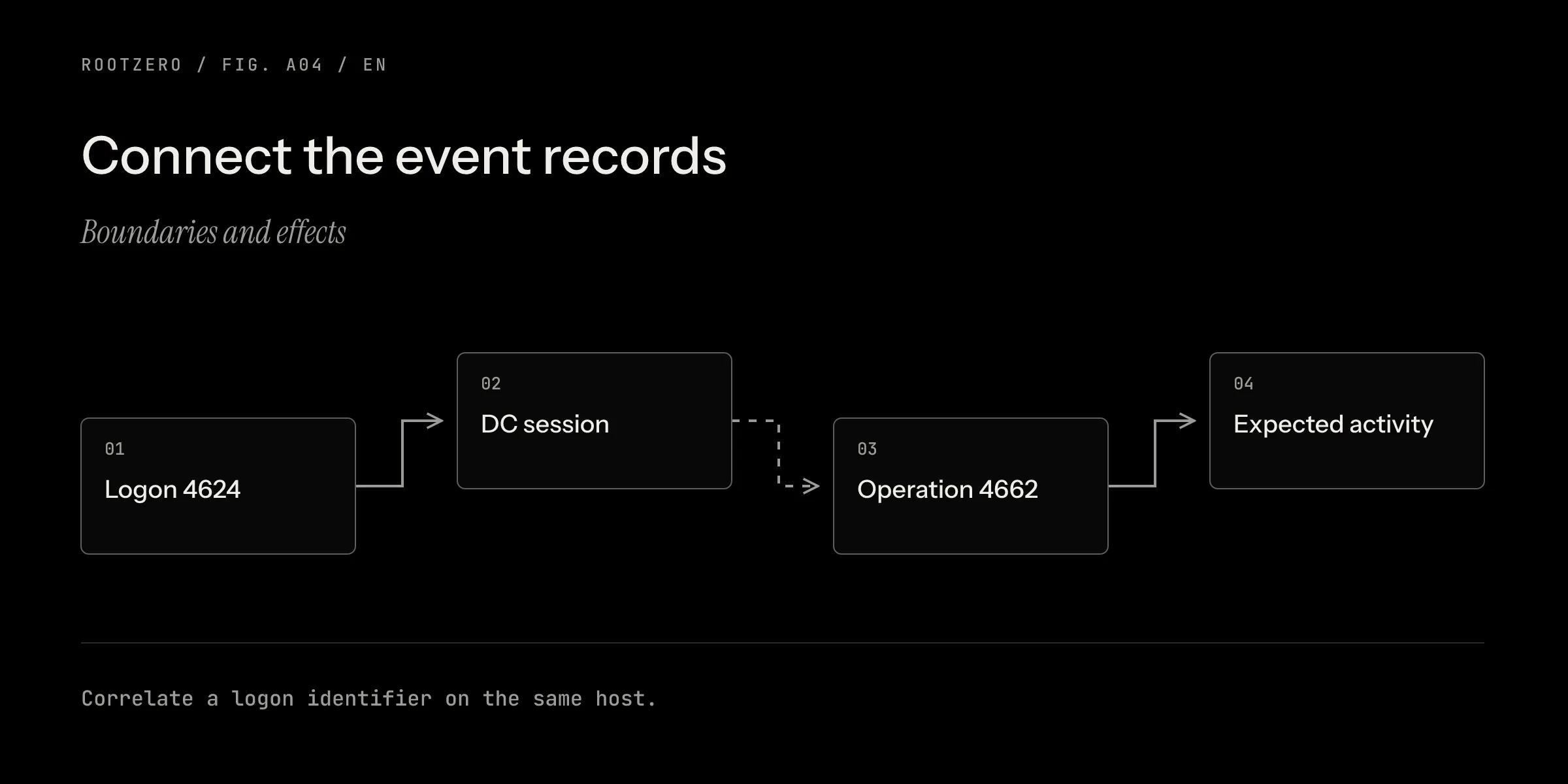
Correlate a logon identifier on the same host.
Verify collection first
Microsoft states that 4662 requires an appropriate SACL. Auditing and collection must cover the operation. An empty window can indicate inactivity, insufficient configuration or lost records.
Event 4624 describes successful logon. Its logon identifier is local to the host. Treating it as a global cross-host key creates false joins.
The demonstration adds boot context to prevent cross-reboot joins. This field belongs to the teaching schema; a real collector must establish that context or recognize that it is missing.
Select a relevant control operation
DS-Replication-Get-Changes-All concerns secret-domain-data replication. A selector can look for its GUID in 4662 properties and the Control Access bit in the access mask.
This does not fully establish DCSync. Review other permissions, account, object and expected machine role. Domain controllers and authorized services may legitimately replicate.
{
  "eventId": 4662,
  "computer": "DC-FIXTURE",
  "boot": "boot-A",
  "subjectLogonId": "0x42",
  "accessMask": "0x100",
  "properties": ["1131f6ad-9c07-11d1-f79f-00c04fc2dcd2"]
}
This is a fictional normalized event, not Windows XML or CyberStrikeAI campaign telemetry.
Replay correlation
Run the downloadable correlator with standard Node modules. From the source repository root:
node docs/drafts/labs/ad-event-correlation.mjsThe local run passes nine cases on this fictional dataset. It joins the 4662 SubjectLogonId to the 4624 TargetLogonId, with the same host and boot context.
Cases distinguish valid matches, another host, another boot, irrelevant masks, absent properties and unknown sessions. They also check identifier normalization, missing boot context and multiple matches. Unmatched signals and ambiguous associations are preserved rather than discarded.
The output selects events for qualification. Expected identities can add context, but must not erase records or establish that an account is uncompromised.
Examine LSASS evidence separately
Sysmon documents ProcessAccess as event 10. Availability depends on sensor configuration. Access to LSASS does not automatically establish creation or retrieval of a dump.
Correlate source process, target, parent, output file and collection records. A command line naming a dump function describes attempted execution until its effect is established. An EDR may block it.
Reconstruct steps with their supporting records and stopping points. Any model generating commands needs separate evidence; the correlator does not infer it from execution speed.