EchoLeak shows how displaying an answer can become a data transfer. Aim Labs research, republished by researcher Itay Ravia, describes an email retrieved by Microsoft 365 Copilot leading to an image request carrying context information. Microsoft’s CVE-2025-32711 record was published on 11 June 2025.
The variant described as zero-click did not require the recipient to open a malicious link. It still required Copilot to retrieve the hostile email and use it in an answer. Delivery and retrieval are separate events. The researcher’s account documents a vulnerability demonstration, rather than a list of affected customers.
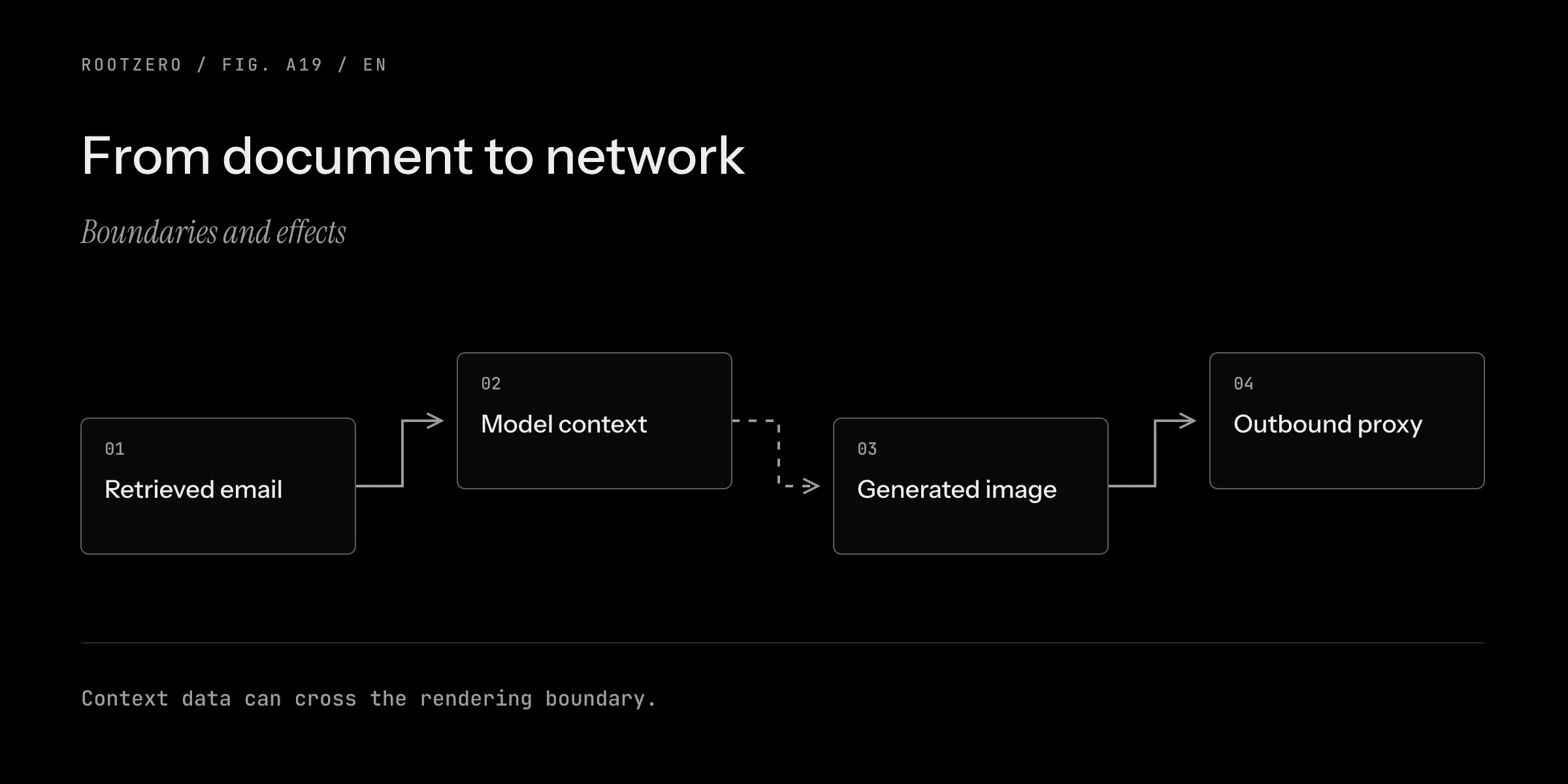
Context data can cross the rendering boundary.
Follow three transformations
An assessment should track three objects: the document supplied to the model, the generated answer and the requests triggered by rendering that answer. Reading the raw response alone can miss the browser’s subsequent behavior.
External content may phrase an instruction as a procedure relevant to the user’s task. The boundary fails when the instruction gains authority over other information in the session. Permission to read a document does not authorize its author to choose where session data goes.
Markdown references can separate an element from its destination. This is ordinary CommonMark image syntax. A filter examining only the immediately visible form of a link may miss the address the renderer resolves.
Remote images can then load automatically. If an image address contains sensitive information, that information enters a network request before the user chooses to follow a link. No attachment or explicit send tool is required on that path.
Locate the proxy’s decision
The published chain used a Microsoft Teams relay on an allowed image domain to fetch another destination. The relevant questions concern the relay’s capabilities and its policy for the final destination. Trust in the first hostname does not answer either question.
A document’s CSP img-src directive controls image sources. It does not, by itself, specify every outbound rule of a server fetching images on the browser’s behalf. Assess the browser and the server separately.
The report also discusses paths with different prerequisites. A SharePoint variant requiring invitation acceptance must not be merged into the zero-click account as though both were one sequence.
Preserve evidence at each stage
An internal evaluation can use a synthetic marker with no business value. Preserve the source document, the excerpt actually retrieved, the exact answer, the rendered DOM and the receiving endpoint’s trace. These artifacts establish different facts.
A marker in the context establishes retrieval. A marker in a generated URL establishes transformation. A marker received by a controlled collector establishes transfer over that path. A missing request requires checking caches, rendering failures and outbound policy before reaching a conclusion.
Controls worth testing include separating document instructions from user authority, restricting session access, treating rendering as an outbound surface and constraining image relays. Each control needs an observable decision at the boundary it protects.
Scope of the account
The research reports a service-side fix and no customers known to have been exploited at disclosure. That dated statement establishes neither later compromise nor the safety of other connected assistants. This analysis examines published sources; we did not reproduce the issue against Microsoft 365 Copilot. The companion rendering protocol explains how to collect evidence using synthetic data.