GhostApproval combines two failures: following a symbolic link beyond the workspace and showing a path that does not describe the actual destination. Approval can cover an apparently local file while the write reaches another location.
In its July 8, 2026 research, Wiz examines six assistants. Behavior and vendor responses differ. The case explains why path presentation belongs in authorization decisions.
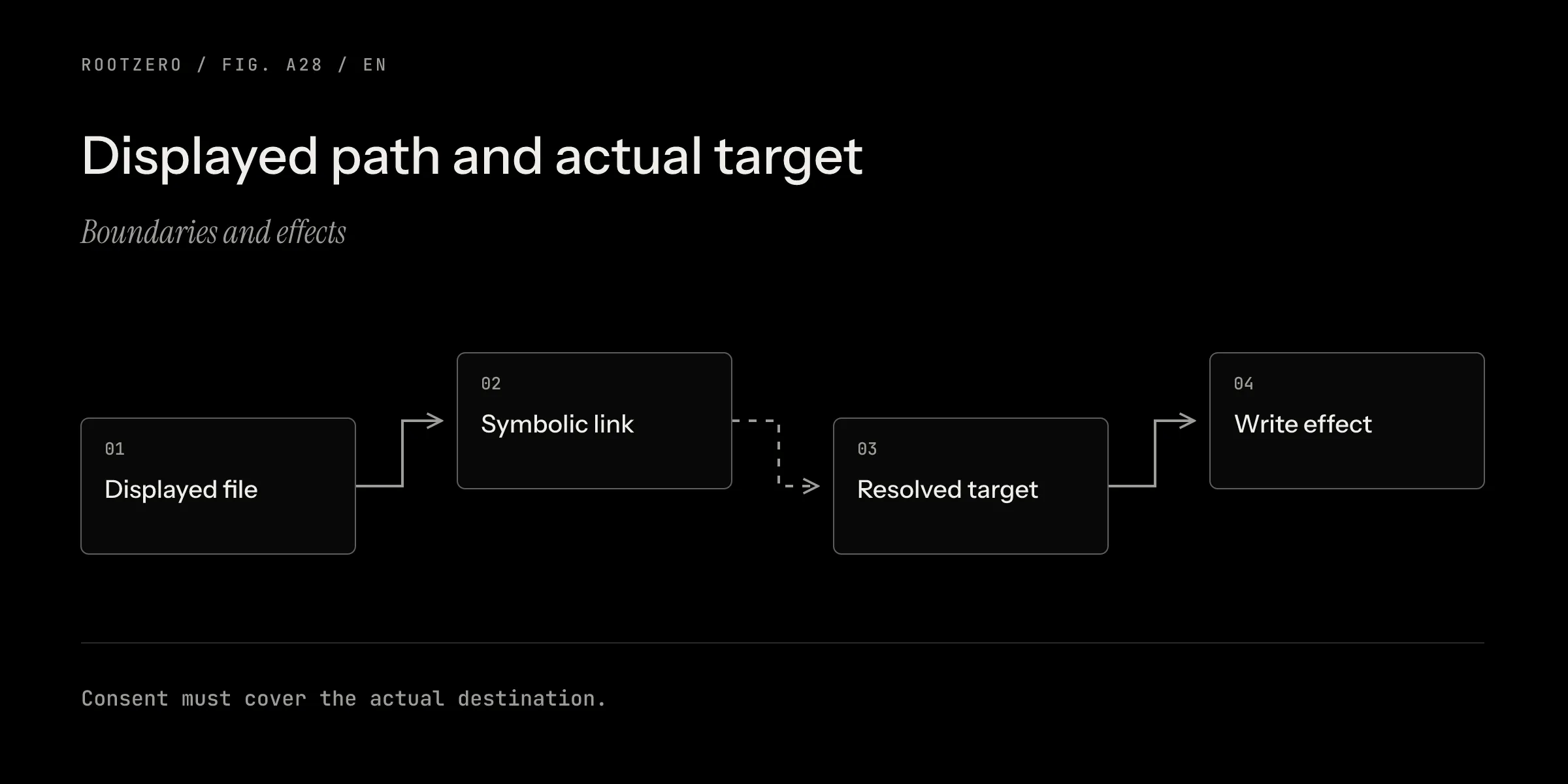
Consent must cover the actual destination.
Naming a file differs from opening an object
In this fictional example, workspace/settings.txt is a link to a file outside the project. Opening it follows the link using the process’s permissions.
displayed path : workspace/settings.txt
resolved object: external-directory/preferences.txt
requested effect: replace contents
A rule comparing only a textual prefix may approve the first string without examining the actual object. This primitive relates to improper symbolic-link following, CWE-61. Incomplete presentation concerns a separate control: representing critical information used for a decision.
Resolving and displaying the target improves the decision but does not make every write safe. Changing the link between checking and opening creates a race. Process permissions and opening mechanisms must preserve the boundary through to the effect.
Bind approval to the action
A useful confirmation identifies requested path, resolved path, operation and scope. Approval must not be reusable for a different destination or payload.
For file creation, the target does not yet exist: inspect its resolved parent directory too. Rules depend on filesystem, links and available APIs. Character normalization alone does not resolve these relationships.
A proposed acceptance matrix follows:
| Case | Expected control |
|---|---|
| Ordinary project file | Destination verified before effect |
| Link outside project | Denial or explicit authorization within scope |
| Link replaced after confirmation | Previous approval does not cover the new target |
| User cancellation | No new write associated with the request |
This is a proposed protocol, not a rootzero reproduction across the six products.
Preserve each vendor’s response
Read Cursor advisory CVE-2026-50549 and AWS bulletin 2026-047 with their versions and conditions. One product’s fix does not describe another’s.
For Claude Code, Wiz reports the threat-model disagreement and Anthropic’s clarification that the symlink warning shipped in version 2.1.32 before the submission. That chronology prevents attributing the change to the report as established fact or treating current versions as identical to the tests.
Verify the effect after the decision
Prepare fictional files in two controlled directories. Record the displayed destination, decision and modified object. Examine denied cases as well: an Undo button appearing after a write does not establish prior refusal.
The evidence concerns the relationship between consent and the actual object. Model reasoning can help explain behavior; it cannot replace file-open records and inspection of the contents after testing.