An issue-triage agent may need repository access, a model call and a proposed label. Package publishing requires a different identity. Combining them in one environment turns an interpretation error into a release capability.
This design concerns GitHub Actions CI. It is not a measured SpectrAI configuration. It assumes external contributors can submit issues and the team retains release approval.
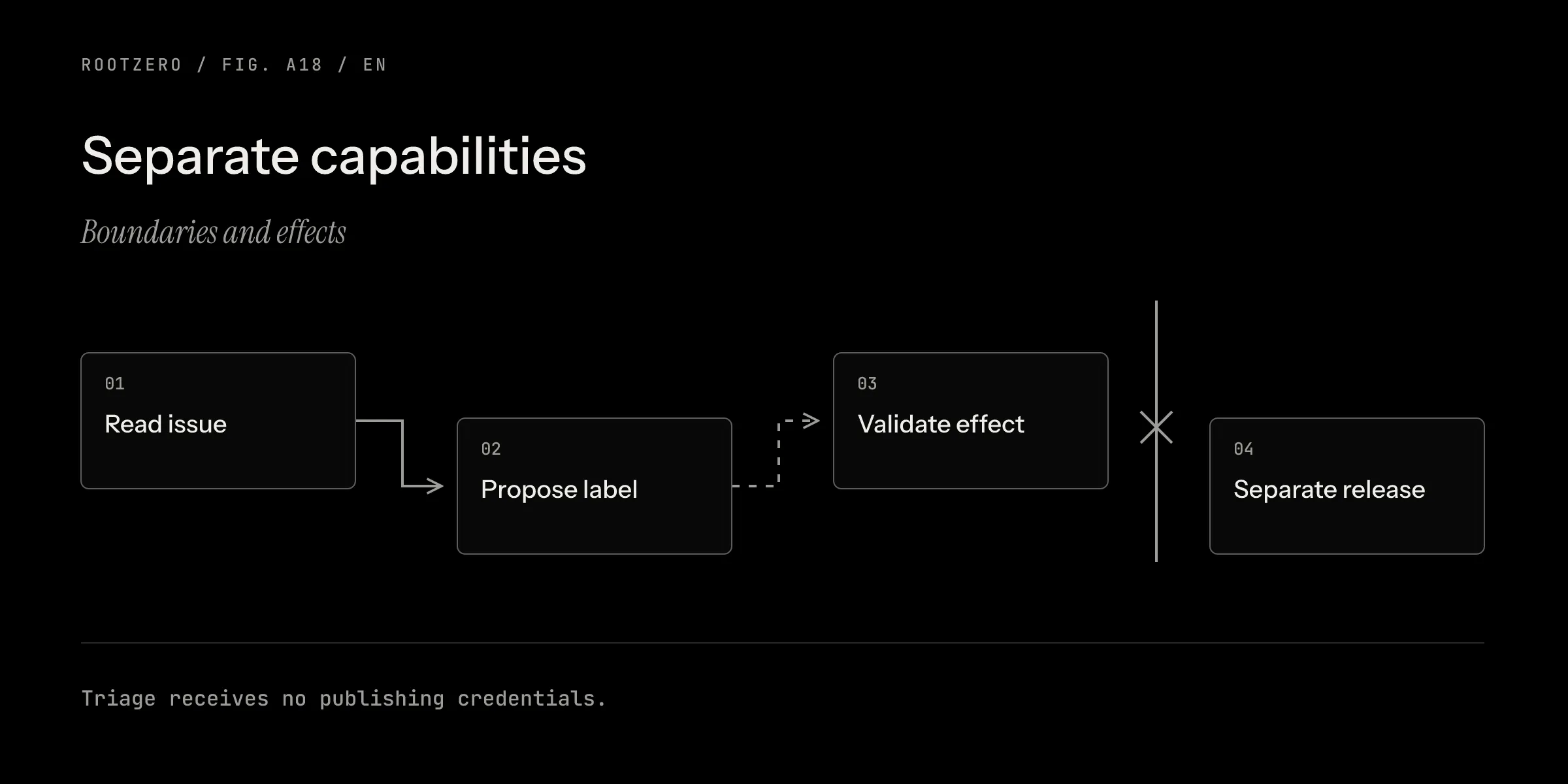
Triage receives no publishing credentials.
Define capabilities first
Write down allowed effects before selecting the model:
| Stage | Input | Allowed effect | Excluded credentials |
|---|---|---|---|
| Analysis | Issue and necessary files | Structured proposal | npm and marketplace publishing |
| Application | Validated proposal | Repository label | Production cloud |
| Release | Approved revision | Build and publish | Developer sessions |
The model-provider account remains a credential or identity requiring protection. Separate jobs do not make it public: constrain its budget, rights and environment. The main reduction here is removing publishing capability while the agent processes public input.
Limit the token per job
GitHub documents GITHUB_TOKEN permissions. Declarations should match each job’s actual effect. This fragment performs no model call or publishing:
permissions: {}

jobs:
  analyze:
    runs-on: ubuntu-latest
    permissions:
      contents: read
    steps:
      - name: Read event metadata
        run: node -e "const fs=require('node:fs');const e=JSON.parse(fs.readFileSync(process.env.GITHUB_EVENT_PATH,'utf8'));console.log(JSON.stringify({number:e.issue?.number}));"
It reads the runner’s event file without interpolating a title into shell program text. It is not a complete triage workflow: the trigger, model invocation and result consumer still need implementation.
Omitting a token from action parameters does not establish that the action cannot access it. GitHub notes that actions can use the github.token context. Review job permissions and action code, then pin executed dependencies.
Pass a bounded proposal
A label proposal can be represented as:
{"issue": 42, "label": "bug"}The applying stage must check that the issue matches the triggering event and the label belongs to a local allowlist. It should not accept model-supplied commands, download URLs or repository destinations.
This boundary limits effects even if the output includes hostile instructions. It does not establish labeling accuracy. That requires a separate annotated dataset and review.
Examine paths around the separation
Jobs can remain connected through executable caches, artifacts or persistent runners. Review outputs as well as tokens. The release workflow should rebuild from an approved revision rather than execute a script delivered by triage.
GitHub describes untrusted-input and privileged-checkout risks. Placing a title in an environment variable can avoid direct shell interpolation while leaving it hostile input to a model. Those are separate mechanisms requiring different controls.
The acceptance question concerns effects: can a hostile issue publish a package, change the release workflow or supply a file that workflow executes? An observable refusal at these boundaries is stronger evidence than a cautionary prompt alone.